Ditch: Pay Off Debt Faster
- 4.8
- Rating
- 10.00K
- Installs
- Free
- Price

 Analysis by App-foxy
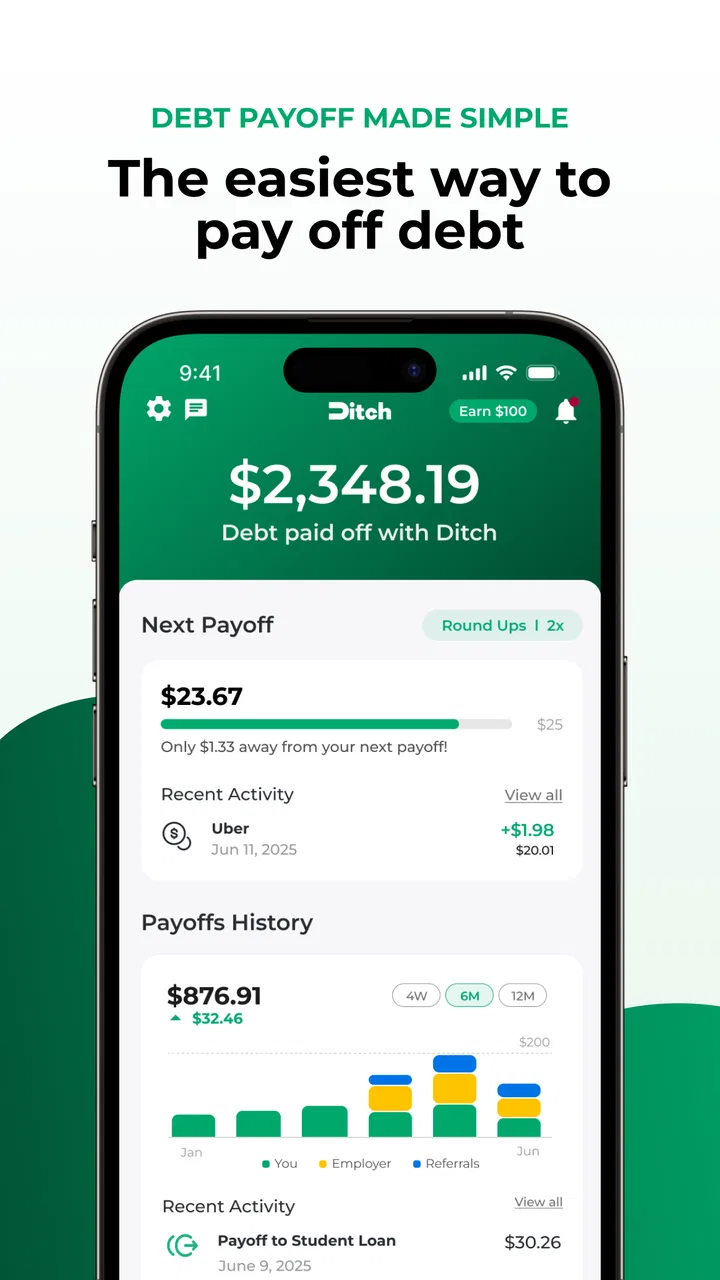
Debt is easy to understand in theory and surprisingly difficult to manage in daily life. A balance can sit quietly in the background while interest, due dates, and several separate accounts make the overall picture feel larger than it really is. I tried Ditch: Pay Off Debt Faster as a finance app with that problem in mind, and my impression is that its main appeal is focus: it is built around organizing debt and helping you move toward paying it down instead of treating it like a general-purpose money dashboard.
That focus makes it more useful for someone who already knows they need a payoff plan but keeps losing momentum. It is less compelling for a person looking for full banking, investing, or expense-management tools in one place. Ditch is developed by Ditch Technologies, Inc, and its store summary centers on automating payoff and tracking debt. That tells you the intended experience immediately: this is a debt companion, not an all-in-one replacement for your bank or budgeting system.
How Ditch fits into a real debt-payoff routine
When I look at a debt app, I care less about whether it can display a balance and more about whether it changes what I do next. A simple list of accounts is useful at the beginning, but it does not necessarily answer the practical questions that cause people to stall: which balance deserves attention first, how much progress has been made, and what should happen after the next payment?
You May Also Like

 AccuWeather: Weather Radar
AccuWeather Review: A Quick, Clear Forecast for Everyday Decisions
For everyday plans, the best forecast is the one you can understand quickly. AccuWeather makes rain timing, radar, and local conditions easy to act on, with a few trade-offs.

 Hill Climb Racing
Why Hill Climb Racing Still Turns Crashes Into One More Run
A tiny car, a bumpy hill and one more upgrade: Hill Climb Racing keeps resurfacing because its simple chaos makes every near-miss feel personal.

 AliExpress - Shopping App
AliExpress Makes Global Shopping Feel Personal, but Shoppers Bear the Risk
AliExpress turns a global marketplace into a pocket-sized discovery engine. Its reach is useful, its shopping loop compelling, and its trade-offs easy to miss.

 Lords Mobile: Kingdom Wars
Lords Mobile Is a Kingdom-Building Routine, Not a Quick Match
A case-by-case verdict on the building, battles, device demands, and social commitments that make Lords Mobile rewarding for some players and exhausting for others.

 PDF Scanner app - TapScanner
TapScanner Makes Paperwork Easier to Capture, Check, and Share
TapScanner makes scanning with a phone feel less like a rescue operation and more like a dependable step in getting work done. Its capture tools are useful, though not flawless.

 Block Blast!
 Shows How Much a Puzzle Game Can Leave Out
A quiet grid game shows why puzzle players increasingly value instant clarity, repeatable skill and low-pressure play—and where the genre still needs to catch up.
More From Our News Desk
View All News


Ditch is aimed at that gap. Its value comes from turning debt from an occasional source of anxiety into something you can review as part of a routine. The tracking side gives you a place to keep the payoff picture visible, while the automation angle is intended to reduce the number of decisions you have to make manually. That combination is important because a plan that depends on remembering every detail every month is fragile.
I would use it after collecting the basic information for each debt: the current balance, required payment, interest details, and payment date. Even if you prefer to keep your everyday spending in a separate budgeting app, putting the payoff obligations together gives you a clearer target. The most useful mindset is to treat Ditch as the control panel for debt reduction, while your bank remains the place where transactions actually happen.
A realistic example is a household with a credit card balance, a personal loan, and a medical bill. The problem is not simply that there are three balances. The problem is that each one has a different deadline and emotional weight. A debt tracker can help you see the combined burden, but a payoff workflow can help you decide what to do after the minimum payments are covered. That is where a focused app can feel more practical than a spreadsheet that you only open when something goes wrong.
What the free entry point means in practice
Ditch is free to download, which makes it relatively easy to test without committing money at the start. The app is rated for Everyone, so its presentation is intended for a broad audience rather than a specialist financial audience. That matters for a debt tool because the people who need it are not always comfortable with complicated financial software.
The free starting point is valuable when you are still deciding whether a dedicated debt workflow fits your habits. I would begin by checking how quickly I can understand the payoff view, how natural it feels to update information, and whether the app supports the way I personally organize obligations. If those basics do not feel comfortable, paying for extra value later would not solve the underlying usability problem.
There are in-app purchases ranging from $5.99 to $89.99 per item. Those figures describe the available purchase range, not a reason to assume that every user needs to pay or that one particular purchase is automatically the best choice. The sensible approach is to use the free access first, identify what part of the workflow you actually need, and then judge whether a paid option saves enough time or adds enough control to justify it.
This distinction is important. A free debt tracker can already be worthwhile if it helps you stop missing information and keeps your payoff goal visible. Paid value only makes sense when it improves a specific recurring task. I would not pay simply because the app is focused or because a purchase exists. I would pay if the upgrade removes a repeated source of friction in my own monthly routine.
Where the app can deliver more value than a spreadsheet
A spreadsheet is flexible, cheap, and familiar, but flexibility can become a weakness. You have to design the structure, maintain formulas, decide which figures matter, and remember to open the file. Ditch has a narrower purpose, and that narrowness is an advantage for someone who does not want to build a debt system from scratch.
The strongest use case is consistency. A dedicated app can make debt review feel like a defined activity instead of another household project that needs maintenance. If I check it on a set day, record changes after payments, and compare the current position with the previous one, the payoff process becomes easier to follow. The app cannot create spare income, but it can reduce the mental effort involved in keeping the plan visible.
Another useful insight is that tracking should happen at two different moments. The first is during planning, when you decide how to direct available money. The second is after a payment clears, when you confirm that the balance and the plan still match reality. Many people only track before paying, then assume everything worked. Using Ditch as a post-payment check can catch stale balances or a forgotten account before they distort the next decision.
I also see value in separating “progress” from “permission to spend.” A falling balance can feel encouraging, but it should not become an excuse to redirect money that still belongs to required payments. The app is most helpful when its progress view supports discipline rather than replacing a complete monthly budget. I would keep a separate view of income, essentials, and upcoming bills, then use Ditch to stay focused on the debt portion.
The tradeoff between automation and personal control
Automation sounds attractive because it removes repeated decisions, but financial automation should never be treated as something to set and forget. Before relying on any automated payoff process, I would verify the account details, payment timing, available cash, and what happens when income changes. A missed payment caused by an over-optimistic automated plan can be more damaging than a few minutes of manual checking.
This is one of the app’s important tradeoffs. The more a user wants Ditch to reduce hands-on work, the more carefully that user should review the setup. Automation is helpful when the underlying information is accurate and the payment money is dependable. It is less suitable for irregular income, frequent account changes, or a household where several people make financial decisions without a shared process.
For that reason, I would create a short monthly checkpoint even if the rest of the routine is automated. I would compare the planned payment with the bank activity, confirm that balances changed as expected, and check whether a new expense has made the old payoff amount unrealistic. This takes away some of the convenience, but it preserves control. In finance, that is a worthwhile exchange.
There is also a behavioral limitation. A debt app can make progress easier to see, but it cannot decide whether paying the highest-interest balance, the smallest balance, or another priority is right for your complete situation. Different strategies can suit different people, and the best choice may depend on interest, fees, available cash, and emotional motivation. I would use Ditch to organize the decision and monitor the result, not to outsource every judgment.
Who is likely to get the most from Ditch
Ditch is a good match for someone with multiple debts who wants one focused place to follow the payoff journey. It should also appeal to people who have tried a spreadsheet but stopped updating it, or who feel that a general budgeting app gives them too much information without enough emphasis on debt reduction.
It can be especially helpful during a transition. If you are moving from minimum payments toward an intentional payoff plan, the app gives you a dedicated project to maintain. I would use it when preparing for a change in income, consolidating household finances, or trying to make a fixed monthly debt amount feel more concrete. The key benefit is not a magical shortcut; it is having a repeatable process.
People who prefer visual progress can also benefit. A debt balance is emotionally difficult because payments may feel small compared with the original amount. Seeing the direction of travel can make the effort less abstract. That psychological effect is not a substitute for accurate numbers, but it can help maintain motivation during the slow middle stage, when the initial enthusiasm has faded.
Another less obvious use is a weekly “decision-free” review. Instead of opening the app only when a bill is due, I would choose a brief recurring check to see whether anything changed. The purpose is not to constantly worry about debt. It is to prevent small oversights from becoming monthly surprises. This works best for users who want structure but do not want to spend a long time maintaining a financial system.
Who should choose a different kind of tool
I would skip Ditch if your main need is transaction categorization, cash-flow forecasting, investment tracking, or detailed household budgeting. A debt-focused app may complement those tools, but it is not the natural first choice when the central problem is understanding every dollar coming in and going out.
I would also be cautious if you need highly customized spreadsheet logic. A spreadsheet can model unusual repayment arrangements, irregular income, shared expenses, and personal formulas in ways a focused mobile app may not. The tradeoff is that you must build and maintain that system yourself. If customization matters more than convenience, the spreadsheet may remain the better fit.
Users who do not want to connect financial information or who prefer entirely manual records should also think about their expectations before starting. A focused tracker can still be useful with careful updates, but the benefit of automation depends on how much setup and ongoing review you are comfortable with. I would not choose any debt app on the assumption that it eliminates the need to check financial activity.
Finally, someone with a single simple balance may not need a dedicated app. If the debt is already easy to monitor and the payment is stable, a calendar reminder and a basic note could be enough. Ditch becomes more convincing as the number of obligations, decisions, or missed updates increases.
What the app’s current profile tells me
Ditch was released on September 12, 2023, and the current version is 1.5.6. It requires Android 8.0 or later, so compatibility should be straightforward for people using a reasonably recent Android device. The app has passed ten thousand installs and holds a 4.8 average from around 1.1 thousand ratings, with 62 written reviews. Those figures suggest a positive response from its early audience, although I would still judge it against my own workflow rather than treating the rating as a guarantee.
The developer, Ditch Technologies, Inc, has chosen a very clear product identity. That clarity is reassuring because the app is not trying to be a broad financial supermarket. At the same time, a narrow identity means the experience must be judged by how well it handles debt organization and payoff habits. If those are not your priorities, the app’s strong focus will feel like a limitation rather than a benefit.
The age rating of Everyone is another sign that the app is intended to be approachable. Still, accessible language does not remove the need for adult financial judgment. Debt decisions can affect payment records, available cash, and household stability, so I would treat the app as an organizing aid rather than financial advice. Before changing a payment plan, I would check the original creditor terms and make sure the proposed amount fits the rest of the budget.
My practical way to test it before paying
I would start with a complete inventory rather than entering only the debt that feels most urgent. Include every obligation you want represented, then compare the app’s picture with statements or current account information. This first pass is where accuracy matters most. A polished payoff view built on incomplete balances can create false confidence.
Next, I would use the app through one ordinary payment cycle. I would note what needs to be updated, how easy it is to understand the next action, and whether the payoff view remains useful after a payment is made. This is a better test than spending a few minutes browsing screens because debt management is a repeated activity, not a one-time setup task.
Before considering an in-app purchase, I would write down the exact problem I want solved. Is it reducing manual work, improving tracking, or keeping the plan more visible? If I cannot name the recurring problem, I would stay with the free option. The purchase range is broad enough that careless upgrading could turn a useful experiment into an unnecessary expense, especially for someone already trying to reduce financial pressure.
I would also decide in advance who is responsible for updates if the app is used by a couple or family. One person should own the weekly or monthly review, while both people should agree on the payoff priorities. Without that agreement, the app may show a plan that looks organized but does not reflect the household’s actual decisions.
My verdict on the value
I like Ditch because it addresses a specific problem instead of burying debt inside a crowded collection of financial features. The free starting point makes it reasonable to test, and the app is most convincing when it helps you build a dependable review habit around several balances. Its automation and tracking focus can reduce mental clutter, particularly for someone who has outgrown notes, reminders, or an abandoned spreadsheet.
My recommendation comes with a clear condition: use it as part of a wider money routine. Keep checking the bank, preserve a realistic cash buffer, and review the payoff plan when income or expenses change. Automation should support attention, not replace it. If you want a complete budget, investment dashboard, or highly customized financial model, another category of tool will serve you better.
For someone specifically searching for a debt payoff app that keeps the goal in view, Ditch is worth trying before considering a purchase. I would stay with the free experience until its daily usefulness is obvious, then compare any paid value with the time and friction it actually removes. My buy-or-skip verdict is simple: try it free if debt organization is your main problem, consider paying only for a clearly needed improvement, and skip it if you really need all-purpose money management.
In my experience, the best reason to recommend Ditch: Pay Off Debt Faster is not that it promises an effortless escape from debt. It is that a focused tool can make the next responsible action easier to see. For the right user, that small improvement in clarity and consistency can be more useful than a much larger app that tries to manage everything at once.
FAQs for Ditch: Pay Off Debt Faster
01What is Ditch: Pay Off Debt Faster, and how does it work?
Ditch: Pay Off Debt Faster is a debt-management app designed to help users organize what they owe and create a clearer repayment plan. After entering information such as balances, interest rates, minimum payments, and due dates, the app can help you understand your debt and compare repayment strategies. It is primarily a planning and tracking tool, not a lender or debt-consolidation service.
02Can Ditch help me choose the best debt repayment strategy?
The app can help you compare common approaches to paying off debt, such as focusing on the highest-interest balance first or paying the smallest balance first for quicker motivational wins. The most suitable strategy depends on your financial situation, interest rates, cash flow, and personal preferences. Any projections should be treated as estimates, since results depend on making payments consistently and keeping account details accurate.
03Do I need to connect my bank or credit-card accounts?
Depending on the version and features available, Ditch may allow you to enter debt information manually and may offer connected-account functionality where supported. Review the permissions and privacy details carefully before linking any financial account. Manual entry can provide more control, but you will need to update balances, payments, and interest information regularly so that the repayment calculations remain useful.
04Is Ditch: Pay Off Debt Faster free to use?
The app’s pricing can vary by platform, region, and subscription plan. Some features may be available at no cost, while advanced planning tools, automation, or additional insights may require an in-app purchase or recurring subscription. Before starting a trial, check the current App Store or Google Play listing for the exact price, renewal terms, cancellation instructions, and whether deleting the app automatically cancels a subscription.
05Is Ditch financial advice, and can it guarantee that I will become debt-free faster?
Ditch should be viewed as an educational budgeting and repayment-planning tool rather than a substitute for a qualified financial adviser. It cannot guarantee a particular payoff date or savings amount because interest rates, fees, income, spending, and unexpected expenses can change. If you are struggling with payments, contact your creditors or a reputable nonprofit debt counselor before relying solely on an app-based plan.
Pros
- Clear payoff tracking helps visualize progress toward becoming debt-free.
- Supports extra-payment planning to estimate how quickly balances can shrink.
- Simple interface makes regular debt updates quick and easy.
- Useful for comparing payoff strategies and prioritizing outstanding balances.
- Progress milestones can provide motivation during a long repayment journey.
Cons
- May require manual balance updates if lender accounts are not supported.
- Results depend on accurate interest rates
- balances
- and payment information.
- Does not replace professional advice for complex financial situations.
- Limited value for users who have no outstanding loans or credit balances.
- Some features may be restricted to a paid plan or require in-app purchases.

Ditch: Pay Off Debt Faster
Gallery